The Bible provides clear evidence that God’s laws from the Torah (the first five books of the Old Testament) remain binding for believers today, including the dietary instructions in Leviticus 11 and Deuteronomy 14 that distinguish between clean and unclean foods. This view is supported by Jesus’ own words, the practices of the apostles, and consistent scriptural themes. Far from abolishing these laws, Jesus upheld them as part of God’s eternal standards for holiness and health. Below, I’ll outline the key facts and proofs from Scripture, along with analyses from scholars who have examined the texts in their original languages and historical contexts. These demonstrate that interpretations claiming the laws were “done away with” often stem from mistranslations, misreadings, or later theological biases.
1. Jesus Explicitly Affirmed the Enduring Nature of the Torah
- In Matthew 5:17-19, Jesus states: “Do not think that I have come to abolish the Law or the Prophets; I have not come to abolish them but to fulfill them. For truly I tell you, until heaven and earth disappear, not the smallest letter, not the least stroke of a pen, will by any means disappear from the Law until everything is accomplished. Therefore anyone who sets aside one of the least of these commands and teaches others accordingly will be called least in the kingdom of heaven, but whoever practices and teaches these commands will be called great in the kingdom of heaven.”
- This is a direct declaration from Jesus that the Torah’s commands—including dietary laws—are not abolished. “Fulfill” here means to properly interpret and live out the law, not end it. Heaven and earth haven’t passed, so the laws stand. Scholars note that Jesus, as a Torah-observant Jew, never violated these laws himself (e.g., he ate kosher Passover meals in Luke 22:7-20).
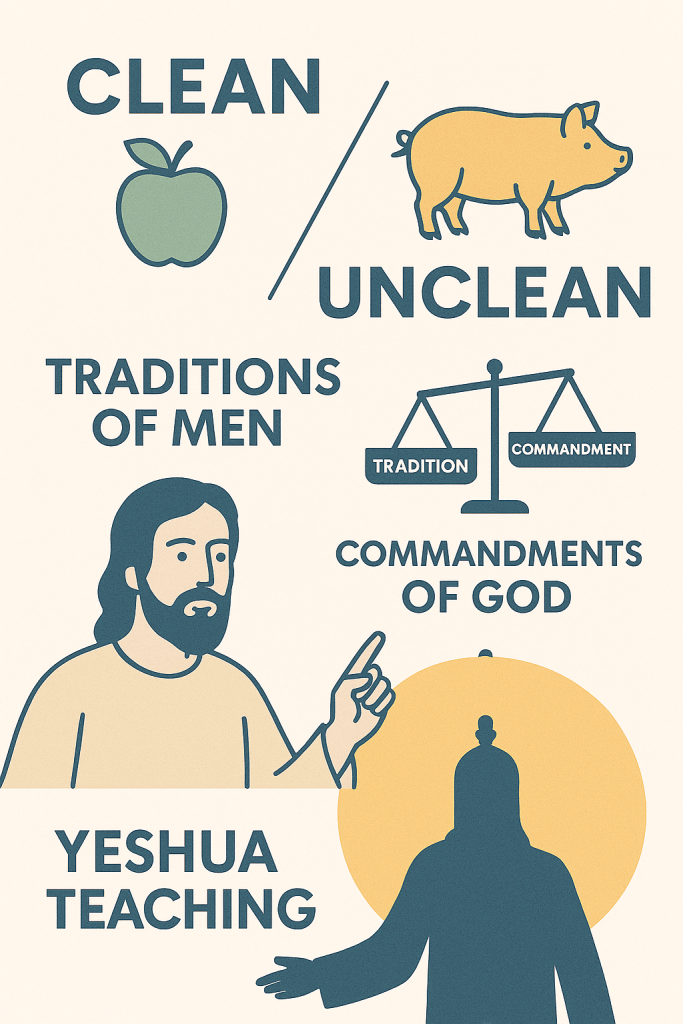
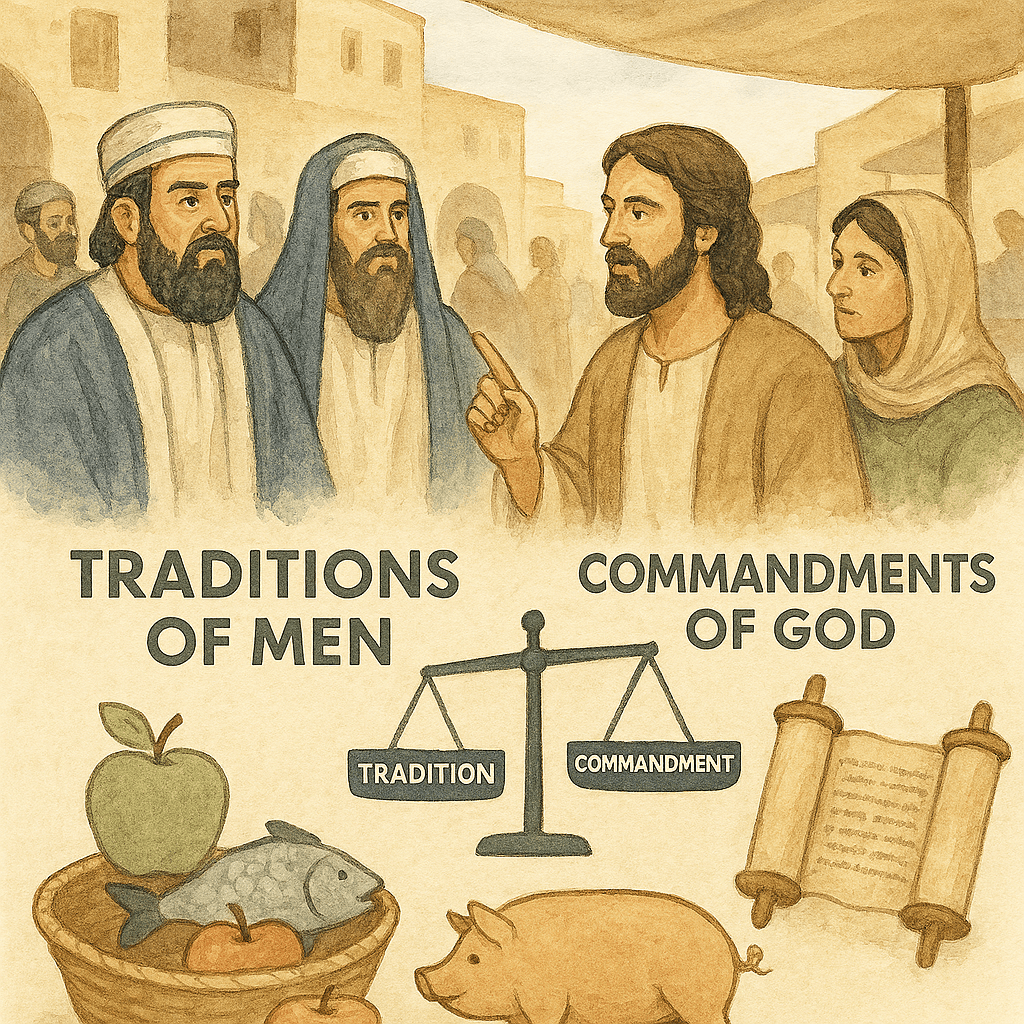
- Jesus’ ministry focused on critiquing human traditions that added to or obscured God’s commands (e.g., Mark 7:6-13, quoting Isaiah 29:13), but he never challenged the Torah itself. If he had declared unclean foods permissible, it would contradict his own statement and cause massive controversy among Jews—yet no such backlash is recorded in the Gospels.
2. The Apostles and Early Church Continued to Observe Dietary Laws
- In Acts 10:14, Peter (a key disciple) declares, “Surely not, Lord! I have never eaten anything impure or unclean,” even years after Jesus’ resurrection. If Jesus had abolished the laws in Mark 7 (as some claim), Peter would have known and adjusted his practice—but he didn’t.
- The Jerusalem Council in Acts 15:19-21 instructed Gentile believers to abstain from blood, strangled animals, and food sacrificed to idols—direct echoes of Torah dietary laws (Leviticus 17:10-14). This wasn’t a “minimum” for Gentiles while Jews kept more; it assumed ongoing Torah observance, with Gentiles learning the full law in synagogues (Acts 15:21).
- Historical records show early Christians, including Gentiles, kept these laws into the second century and beyond. The Didache (an early Christian manual) urges followers to “bear what you are able” regarding food, referring to Old Testament prohibitions. Even fourth-century sources document Jewish and Gentile Christians avoiding unclean meats.
3. Mark 7:19 Does Not Abolish Dietary Laws—It’s About Ritual Handwashing and Moral Defilement
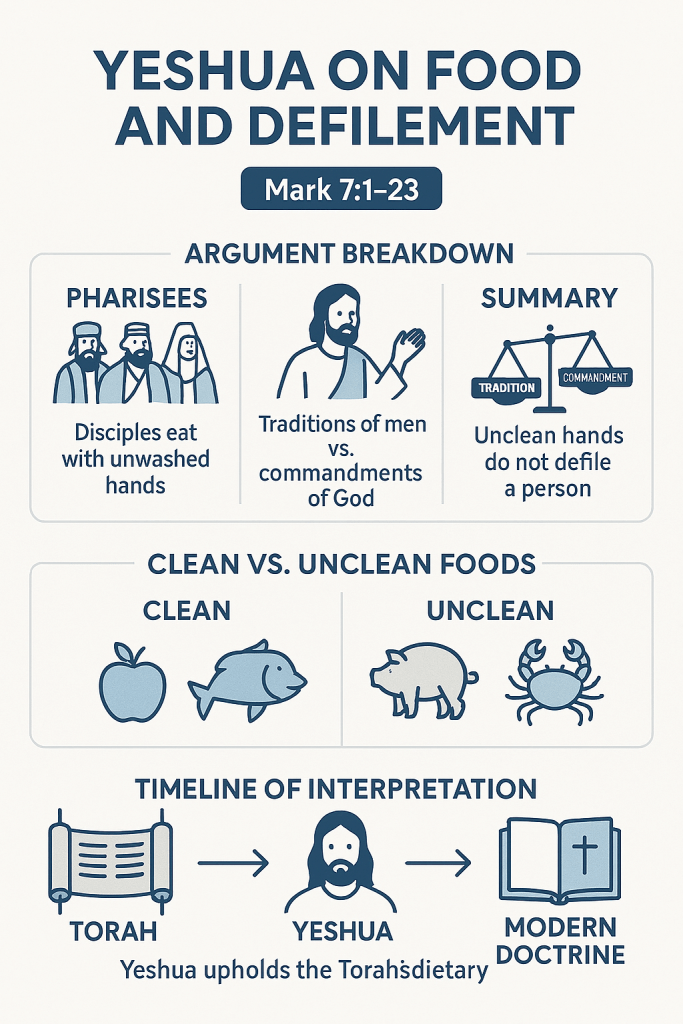
- The passage in Mark 7:1-23 addresses Pharisees criticizing Jesus’ disciples for eating with unwashed hands—a man-made tradition from oral law (later Talmud), not the Torah. Jesus shifts focus to internal sin (e.g., evil thoughts from the heart) defiling a person, not external rituals.
- The key phrase in Mark 7:19—”Thus he declared all foods clean” (in some translations)—is a parenthetical addition by translators, not in the original Greek. The Greek text reads: “because it enters not his heart but his stomach, and is expelled? (Thus purifying all foods.)” The masculine participle “purifying” (katharizōn) refers to the digestive process expelling impurities, not Jesus declaring unclean animals edible.
- “Foods” (brōmata) here means biblically permitted items that might be ritually defiled by unwashed hands—not including unclean animals, which Jews didn’t consider “food” at all. Jesus is saying ritually impure clean food doesn’t spiritually defile you because digestion purifies it. This aligns with Jewish views that excrement is ritually pure, so the stomach acts as a purifying agent.
- Matthew’s parallel (Matthew 15:1-20) omits any “all foods clean” phrase and concludes: “To eat with unwashed hands does not defile anyone” (v. 20)—confirming the focus on traditions, not Torah laws.
- Scholars like David Wilber and Logan Williams argue this is a misreading; Mark portrays Jesus as Torah-faithful, not abrogating laws. Early manuscripts support the text as commentary on digestion, not abolition.
4. Health and Holiness Benefits Confirm the Laws’ Ongoing Relevance
- The dietary laws aren’t arbitrary; they protect health. Unclean animals (e.g., pork, shellfish) carry parasites and diseases like trichinosis and vibriosis, risks known today but embedded in God’s wisdom centuries ago. Modern science validates these as “sound medical reasons” for avoidance, as noted in commentaries like Eerdmans Handbook to the Bible.
- They also promote holiness: Leviticus 11:44-45 commands, “Be holy, because I am holy”—a call echoed in 1 Peter 1:15-16 for New Testament believers. Obeying distinguishes God’s people (Deuteronomy 14:2).
- Groups like Messianic Jews and Hebrew Roots adherents today keep these laws, citing unchanged biblical mandates.
5. Other New Testament Passages Often Misinterpreted
- Romans 14 and Colossians 2:16-17 discuss judging over food preferences or festivals among believers, not abolishing laws. Paul, a Torah-keeper (Acts 21:24), addresses asceticism or pagan influences, not unclean meats.
- Acts 10 (Peter’s vision) uses unclean animals as a metaphor for Gentile inclusion (Acts 10:28), not literal permission to eat them. Peter interprets it as about people, not food.
- 1 Timothy 4:4 says “everything God created is good,” but contextually refers to foods God deemed clean, not overriding Leviticus.
In summary, the facts from Scripture—Jesus’ affirmations, apostolic practices, and contextual readings—prove the Torah laws, including dietary, apply today as God’s unchanging standards for obedience, health, and holiness. Claims of abolition often ignore original contexts and add interpretive biases. For deeper study, resources like David Wilber’s articles or Torah Class teachings provide rigorous, evidence-based support.
Bibliography
Wilber, D. (2022, July 24). Did Jesus reject the Torah’s dietary laws? (Mark 7:1-23). David Wilber. https://davidwilber.com/articles/did-jesus-reject-the-torahs-dietary-laws-mark
Williams, L. (2024, November 1). Does Jesus ‘declare all foods clean’ in Mark 7.19? Psephizo. https://www.psephizo.com/biblical-studies/does-jesus-declare-all-foods-clean-in-mark-7-19
First Fruits of Zion. (n.d.). All foods clean? Torah Portions. https://ffoz.org/torahportions/commentary/all-foods-clean
Rudolph, D. (n.d.). Jesus and the food laws: A reassessment of Mark 7:19b [PDF]. Academia.edu. https://www.academia.edu/1622551/Jesus_and_the_Food_Laws_A_Reassessment_of_Mark_7_19b
Solberg, R. L. (n.d.). Did Jesus declare all foods clean? (Mark 7) [Video]. YouTube. https://www.youtube.com/watch?v=07Gpo0i5Iww
Solberg, R. L. (n.d.). Mark 7:19 manuscript evidence: Did Jesus really declare all foods clean? [Video]. YouTube. https://www.youtube.com/watch?v=S5MNHlYw73E
Mueller, E. (2015). Cleansing the common: A narrative-intertextual study of Mark 7:1-23 [PDF]. Andrews University. https://digitalcommons.andrews.edu/cgi/viewcontent.cgi?article=2837&context=dissertations
Ministry Magazine. (1999, June). Clean and unclean meat. https://www.ministrymagazine.org/archive/1999/06/clean-and-unclean-meat
Marcus, J. (2012, March 2). Jesus kept kosher: The Jewish Christ of the Gospel of Mark. Tikkun Magazine. https://www.tikkun.org/jesus-kept-kosher-the-jewish-christ-of-the-gospel-of-mark
ResearchGate. (2018, December 23). Did Jesus really declare all food clean? [PDF]. https://www.researchgate.net/publication/329876714_DID_JESUS_REALLY_DECLARE_ALL_FOOD_CLEAN
TorahResource. (n.d.). Did God change his mind about food. https://torahresource.com/article/did-god-change-his-mind-about-food
Two Journeys. (2022, November 20). Jesus declared all foods clean (Mark Sermon 32). https://twojourneys.org/sermons/series/mark/jesus-declared-all-foods-clean-mark-sermon-32
Jerusalem Perspective. (2008, December 2). Mark 7:19: Did Jesus make “unclean” food “clean”?. https://www.jerusalemperspective.com/4572?srsltid=AfmBOoqdiNA5V6CQRYsKHskdVyt3yOej1B8F6K3612SdODr7q6iDlZu-
The Return of Benjamin. (2015, May 5). From HebrewRoot: Mark 7:19 and Acts 10-11. WordPress.com. https://returnofbenjamin.wordpress.com/2015/05/05/from-hebrewroot-mark-719-and-acts-10-11
Modern Reformation. (2026, January 6). Don’t rebuild what Christ fulfilled: The case against “Bible Diets”. https://www.modernreformation.org/resources/essays/dont-rebuild-what-christ-fulfilled-the-case-against-bible-diets
Torah Club. (n.d.). It certainly appears from Mark 7 that “Jesus declared all foods clean.” But is that really what… [Video]. Facebook. https://www.facebook.com/torahclub/videos/did-jesus-declare-all-foods-clean/217676390200377
Solberg, R. L. (n.d.). Clean & unclean foods (Part 1 of 2) – Examining Monte Judah’s teaching on the kosher food laws [Video]. YouTube. https://www.youtube.com/watch?v=UrhflvHknys
Morning Meditations. (2013, December 11). FFOZ TV review: All foods clean. https://mymorningmeditations.com/2013/12/11/ffoz-tv-review-all-foods-clean
 VeteranJaime
Leave a comment