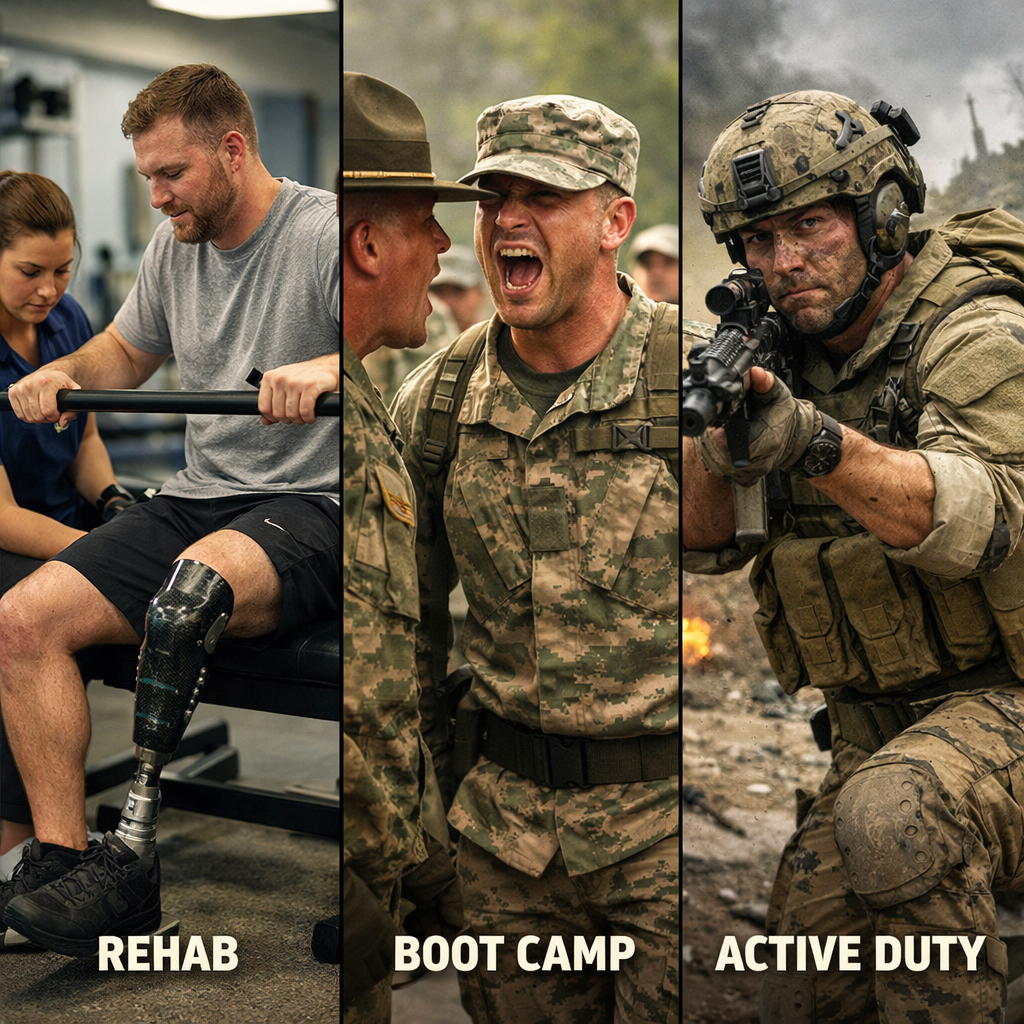
Every warrior’s journey has stages. In the military, you lived them without ever naming them:
- Boot camp — learn the fundamentals
- Deployment — adapt the fundamentals
- Leadership — create your own way
This progression exists in martial arts too, and the Japanese have a name for it:
Shu–Ha–Ri.
It’s a roadmap for mastery — not just in combat or art, but in fitness, discipline, and personal growth. For veterans rebuilding their bodies after service, Shu–Ha–Ri becomes a powerful framework for training with clarity, humility, and purpose.
What Shu–Ha–Ri Really Means
Shu–Ha–Ri describes the three stages of learning:
1. Shu — “Obey”
Learn the basics. Follow the fundamentals. Build the foundation.
2. Ha — “Detach”
Adapt the basics. Modify them to fit your body, your injuries, your life.
3. Ri — “Transcend”
Create your own style. Move with mastery. Train as the warrior you’ve become.
This is not a linear path — it’s a cycle. And veterans often try to jump straight to Ri, skipping the rebuilding stages entirely.
Shu–Ha–Ri brings you back to the beginning — not as a beginner, but as a warrior refining his craft.
Why Shu–Ha–Ri Matters for Veterans
After service, many veterans struggle with:
- Comparing themselves to who they used to be
- Feeling frustrated by lost strength or mobility
- Trying to train at advanced levels without a foundation
- Ignoring injuries or limitations
- Feeling ashamed of starting over
Shu–Ha–Ri removes the shame. It reframes “starting over” as a return to mastery, not a regression.
You’re not going backward. You’re rebuilding — with wisdom this time.
Stage 1: Shu — Return to the Fundamentals
Shu is humility. It’s the willingness to say:
“I will rebuild my foundation.”
For veterans, Shu means:
- Relearning proper form
- Starting with bodyweight movements
- Focusing on mobility and stability
- Respecting old injuries
- Training with patience, not ego
Examples of Shu-level training:
- Push-ups with perfect form
- Air squats
- Dead hangs
- Planks
- Walking or light jogging
- Basic stretching
Shu is not weakness. Shu is discipline.
It’s the same discipline that made you a warrior in the first place.
Stage 2: Ha — Adapt and Evolve
Once the fundamentals are solid, you enter Ha — the stage of adaptation.
This is where veterans thrive.
Ha means:
- Modifying movements to fit your body
- Adjusting volume and intensity
- Exploring new training styles
- Learning what works for your injuries, age, and goals
- Breaking away from rigid rules
Examples of Ha-level training:
- Weighted calisthenics
- Hybrid strength training
- Martial arts conditioning
- Tactical fitness
- Mobility flows
- Interval training
Ha is where you begin to reclaim your identity — not as who you were, but as who you are now.
Stage 3: Ri — Create Your Own Way
Ri is mastery.
Not perfection. Not ego. Not comparison.
Mastery.
Ri means:
- You know your body
- You know your limits
- You know your strengths
- You train with intention, not impulse
- You move with confidence, not fear
Examples of Ri-level training:
- Designing your own workouts
- Combining disciplines (calisthenics + martial arts + strength)
- Training for personal missions (rucking, hiking, competitions)
- Teaching or mentoring others
- Using fitness as a form of leadership and service
Ri is the stage where fitness becomes part of your identity again — not because you’re chasing the past, but because you’ve built something new.
How Shu–Ha–Ri Strengthens the Veteran Spirit
Shu–Ha–Ri mirrors the military journey:
- Shu — Boot camp
- Ha — Deployment
- Ri — Leadership
It honors the warrior path while giving veterans a structured, compassionate way to rebuild.
Shu–Ha–Ri teaches:
- Humility
- Adaptability
- Mastery
- Patience
- Self-respect
It reminds you that mastery is not about being the strongest — it’s about being the most intentional.
Your Mission for the Next 24 Hours
Identify which stage you’re in:
- Shu: Rebuilding fundamentals
- Ha: Adapting and evolving
- Ri: Creating your own path
Then choose one action that aligns with that stage:
- Shu → Practice perfect push-up form
- Ha → Modify a movement to fit your body
- Ri → Design a short workout that reflects your style
Shu–Ha–Ri is the warrior’s roadmap. Follow it, and your fitness becomes a craft — not a chore.






Leave a Reply