
Across the veteran community, stories of sacrifice, accountability, and ongoing challenges continue to shape the national conversation. Three recent reports highlight the breadth of issues affecting service members past and present—from honoring America’s earliest overseas war dead, to confronting large‑scale fraud against VA programs, to understanding new research on toxic exposures and suicide risk.
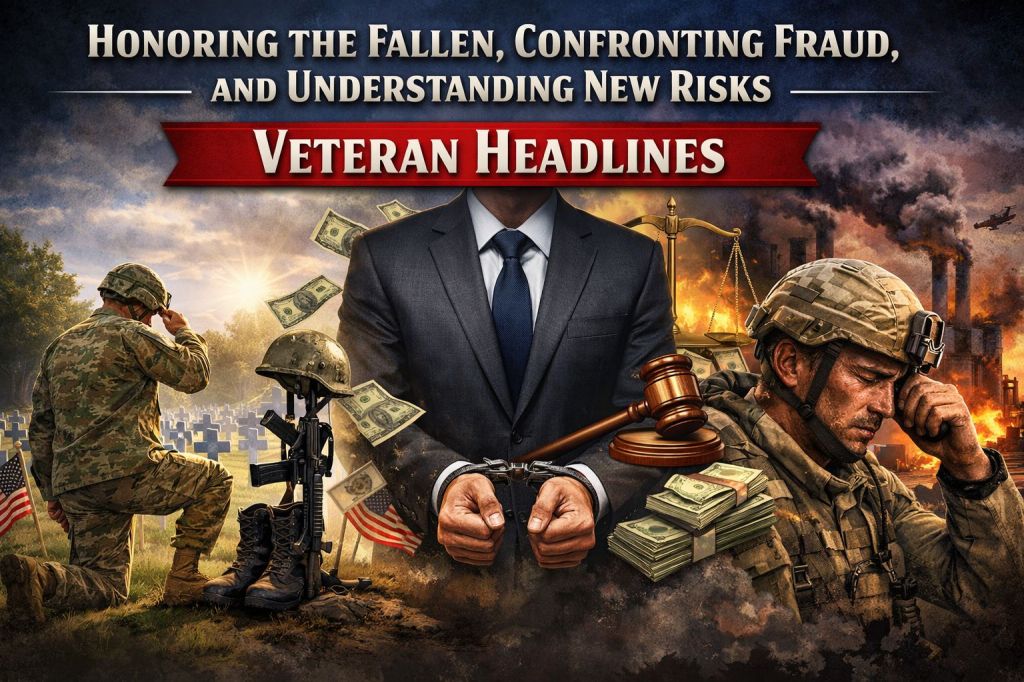
Honoring America’s First Overseas Fallen
In Italy, U.S. troops gathered to pay tribute to some of the earliest American service members to die on foreign soil. These men, unknown to the troops who honored them, represent the long lineage of Americans who have served—and sacrificed—far from home. Their graves stand as reminders that the tradition of overseas service did not begin in the modern era; it stretches back generations.
The ceremony underscored a timeless truth: honoring the fallen is not just about remembering history, but about reinforcing the values that bind today’s military community to those who came before. For many service members, these moments reaffirm the continuity of duty, sacrifice, and shared identity.
Former NFL Player Sentenced in Massive Medicare and VA Fraud Scheme
A former NFL tight end was sentenced to more than 16 years in federal prison after orchestrating a years-long fraud scheme that drained nearly $200 million from Medicare and the Department of Veterans Affairs. According to reporting from Military Times, the scheme exploited medical reimbursement systems intended to support veterans and seniors.
For the veteran community, cases like this cut deep. Fraud against the VA is not just a financial crime—it’s a betrayal of trust. Every dollar stolen is a dollar diverted from veterans who rely on these programs for care, rehabilitation, and stability. The sentencing sends a strong message: exploiting systems designed to support veterans will be met with serious consequences.
VA Study Finds Link Between Toxic Exposures and Suicide Risk
A new Department of Veterans Affairs study reported by Stars and Stripes reveals a troubling connection: veterans who experienced multiple toxic exposures during service are significantly more likely to report suicidal thoughts and behaviors than those without such exposures.
This research adds to a growing body of evidence showing that toxic exposure is not just a physical health issue—it’s a mental health one as well. From burn pits to chemical hazards, many veterans carry invisible burdens that compound over time. The study reinforces the need for continued investment in exposure‑related healthcare, mental health support, and early intervention strategies.
For veterans and advocates, the findings validate what many have long voiced: toxic exposure doesn’t end when service ends, and its effects can ripple across every part of a veteran’s life.






 VeteranJaime
Leave a comment